
A COUNTRY RECLAIMED
Last week, Peter Silverman and I drove to San Salvador, the capital of El Salvador. I have made this trip many times before, almost exclusively taking this route on my way to Honduras. This time, I visited to better understand whether the population of street-living children in Latin America was truly declining.
I found myself looking out the window more than usual and pondering what was racing through my head.
Children walked to school in clean, neat uniforms, backpacks slung over their shoulders. Street vendors chatted calmly with customers. Families waited at bus stops. Parks were busy. Shops were flourishing. Life seemed… ordinary.
For me, this ordinary scene felt anything but ordinary. Ten years ago, I had walked the length of El Salvador, during the first Camino por Amor walk from Costa Rica to Guatemala. I remember passing through neighbourhoods where gangs controlled the streets, where people spoke quietly about violence, and where children grew up knowing that crossing invisible boundaries could cost them their lives. Looking out of the window now, I found myself wondering whether I was really looking at the same country.
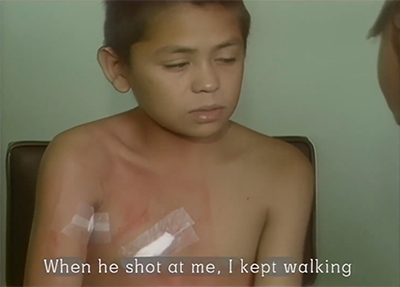
In 2015, El Salvador recorded one of the highest homicide rates in the world—around 106 murders for every 100,000 people. More than 6,600 people were killed in a single year, and entire neighbourhoods lived under the control of gangs. Many communities were divided by invisible borders that residents dared not cross for fear of being attacked or killed. Children often grew up believing that joining a gang was not simply an option, but an expectation.
 Today, the contrast is remarkable.
Official figures report that the homicide rate fell to 1.9 per 100,000 people in 2024, one of the lowest in the Americas. Streets once avoided are now busy with families; businesses have reopened, and tourism has returned to places that for years were associated only with fear.
The transformation has been dramatic, although it has also sparked international debate. Most Salvadorans speak glowingly of Nayib Bukele, the president who has led the transformation, arresting and imprisoning over 90,000 gang members, investing in major infrastructure projects, and building hundreds of new roads, schools and hospitals.
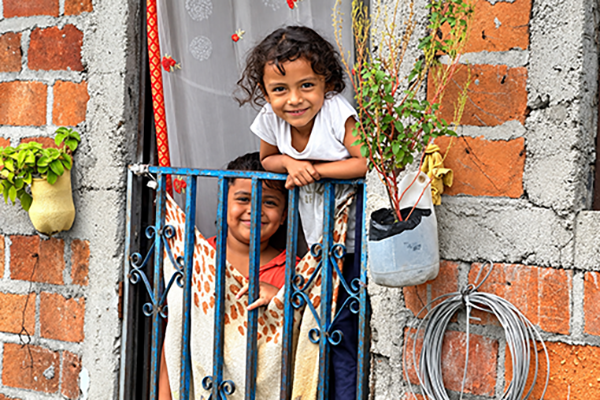
As I watched the city pass by outside my window, I wasn’t thinking about homicide rates or politics. I was thinking about children. How different must it feel to grow up in a place where gunfire no longer shapes your childhood? What does hope look like for a generation that may never know the fear their parents lived with every day?
For some time, Peter and I had been planning this trip to begin what we hoped would become a study into the actual number of street-living children in El Salvador.
The last reliable figures we could find dated back almost thirty years. The U.S. Department of State’s 1997 Human Rights Report estimated that around 1,000 children were living on the streets of El Salvador, with nearly 40% of them under the age of five.
Over the years, however, I had noticed something else. Fewer unaccompanied children were arriving in Guatemala from El Salvador in search of safety or a better future. Had something changed?
 As we researched the country before travelling, reading reports, academic papers and scanning social media sites, all seemed to point in the same direction. The number of children living on the streets now seemed remarkably low. But we wanted to find out for ourselves.
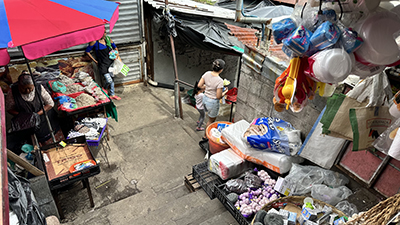
Walking through the streets of San Salvador was both exciting and eye-opening. The transformation of the city centre is remarkable. What was once a sprawling urban slum in the 1980s has become a vibrant public space, with beautifully restored buildings, a bustling central square, and an ambitious cable car network that promises to connect some of the city’s poorest hillside communities to the central zone, and to snazzy new malls that are springing up everywhere.
But it doesn’t take long before another San Salvador begins to emerge. Hidden behind the restored façades are reminders of the old city. Turn down the right street, and you could almost believe you had stepped back forty years.
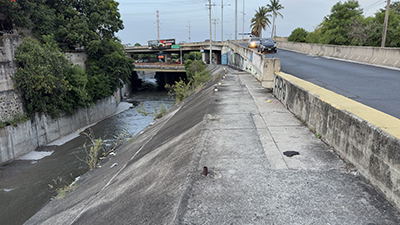
Those streets became our home for the next few days as we walked, observed, spoke with local people, and eventually spent time with a small group of homeless men and teenage boys who had made their home beneath a large flyover.
About a dozen homeless men welcomed us into their community. They seemed genuinely pleased to meet us and readily invited us into the space they now called home. They seemed open to us understanding their lives and, in return, we wanted to tell them more about ours, including showing photos of Guatemala and Buckingham Palace.
One man, who was clearly the leader of the group, patiently answered our questions. When I asked about street-living children, his reply surprised me. “There aren’t any anymore,” he said. “If children are found living on the streets, the government comes and takes them into care.”
No sooner had he finished speaking than a young boy wandered into the group. He couldn’t have been much older than twelve. He wasn’t interested in us. Instead, he kicked an empty cardboard box across the ground, then asked the men if anyone had any food.
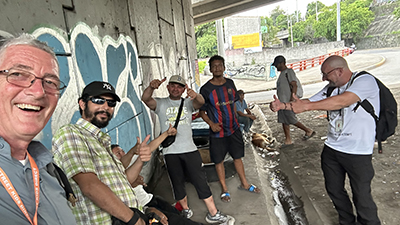 Something about him immediately caught my attention. His worn shoes, grubby oversized clothes, weathered appearance and black eye suggested that he either lived on the streets or spent much of his life there. He looked completely at home among the homeless men.
A little later, he wandered over to where I was now sitting on a discarded mattress, and we began to talk. Our conversation was brief, but it revealed something important. Another boy of a similar age also spent time with the group, and two younger teenagers often joined them.
Suddenly, the picture became less clear-cut than the statistics and official reports had suggested. Were there really no street-living children in El Salvador, or had they simply become harder to find? The pieces were beginning to come together.
The next stage of our visit took us away from the streets and into smart air-conditioned offices.
Over the following two days, Peter and I met with both governmental and non-governmental organisations to build a much wider picture. We wanted to understand not only the current situation of street-living children, but also how it had changed over the years. What surveys had been carried out? What support now existed for vulnerable children? And how did the legal system respond when a child was found living on the streets?
One of the biggest surprises for me was just how recent much of this work is.
The government department responsible for protecting vulnerable children—the closest equivalent to the UK’s Child Protection Services—was established only three years earlier. It began with just nine staff members. Today, it has grown to more than 700, reflecting the government’s remarkable commitment to identifying and protecting children at risk.
Every organisation we visited was open, welcoming and willing to share what they had learned. Rather than seeing us as outsiders, they invited Street Kids Direct to return and continue the conversation, particularly around our experience of prevention work and mentoring programmes for children at risk.
As the meetings continued, the same picture began to emerge. Everything we were seeing, from the streets, from the homeless community beneath the flyover, and from the organisations working with vulnerable children, pointed in the same direction.
Street-living children have become exceptionally rare in El Salvador. That does not mean the work is finished. There are still children living in neglect, children sleeping in unsafe homes, and children vulnerable to abuse and exploitation. The challenge has changed, but it has not disappeared.
For more than thirty years I have carried a simple vision: to see no more street-living children. Walking the streets of San Salvador, I realised that what once felt like an impossible dream may already be becoming a reality.
Until the last child!
Your Content Goes Here
CLICK HERE to find out the answer and how you could help educate a child at risk in Guatemala today
 Duncan Dyason is the founder and Director of Street Kids Direct and founder of TOYBOX UK, El Castillo in Guatemala and SKDGuatemala. He first started working with street children in 1992, when he moved to Guatemala City after watching the harrowing BBC documentary “