
“HE IS STILL HERE INSIDE”
Sunday 11th October, 2026
All children reach a stage in life when they realise that growing up brings a whole new set of expectations and responsibilities. For many, early childhood is relatively carefree, filled with fun, friendships, and the excitement of discovering the world through play. Then comes that awkward stage between childhood and adolescence, when the world starts to expect more of them, their bodies begin to change, and life suddenly gets a little more complicated.
It can be confusing and challenging, especially when children are expected to behave more like adults while still trying to understand what it means to be a child.
You might be wondering why I am reflecting on childhood development in this week’s blog. Three things happened this week that made me stop and think about how often we view growing up through our own adult eyes rather than the children’s. It left me wondering whether understanding their perspective a little better might change not only how we relate to them, but also how we support them through these important years.
I couldn’t help but smile as Moses, who had just turned nineteen, sat in the front passenger seat of my car, sharing his newly acquired driving knowledge and offering a few helpful observations about my own driving.
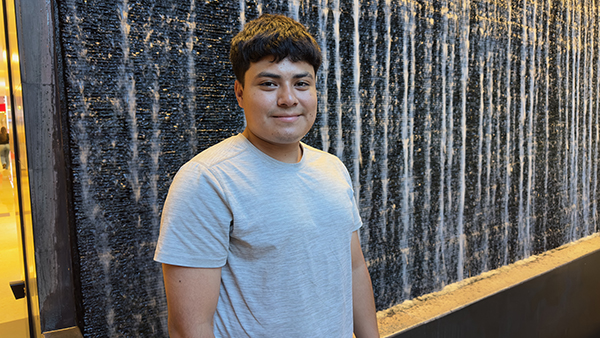 I was amused because Moses had just completed his first two hours of lessons at a local driving school. Apparently, here in Guatemala, just nine hours of instruction is enough to apply for a driving licence, and the practical assessment involves little more than driving around a yard while attempting to avoid a few strategically placed plastic cones!
After just two hours behind the wheel, Moses had clearly become something of an expert, and I was now benefiting from his professional advice. When I parked the car, he immediately got out to check that I had positioned it exactly in the middle of the parking space, which, of course, I had. He also carefully checked that the car was perfectly parallel to the painted lines, which, naturally, it was!
As we wandered around the shops, Moses simply couldn’t stop talking about driving. He was amazed at how many people made such basic mistakes, why drivers insisted on getting so close to the vehicles in front of them, and why anyone would need several attempts to parallel park when, apparently, it was all so straightforward.
I wish I had recorded the conversation! It was one of those wonderfully entertaining moments that I knew I would remember for a long time. For now, however, I got to enjoy it myself, and I am delighted to share it with you now.
But as I listened to Moses, I began to realise that something much more important was happening.
For me, driving is something I have done for decades, often without giving it a second thought. For Moses, however, those first two hours behind the wheel represented something significant. He was learning a new skill, gaining independence and taking another step towards adulthood. It was a moment of achievement, and he wanted someone to share in his excitement.
It reminded me how easily we can overlook the importance of these milestones in children’s and young people’s lives. What might seem quite ordinary to us can represent a huge step forward for them.
Our role is not simply to recognise these moments, but to listen, encourage, and share in their excitement, even when that means accepting a little driving advice from someone who’s only been behind the wheel for two hours!
The following day, I headed to Santa Faz, excited to see the children and the team after a couple of weeks when other work had kept me away from the centre.
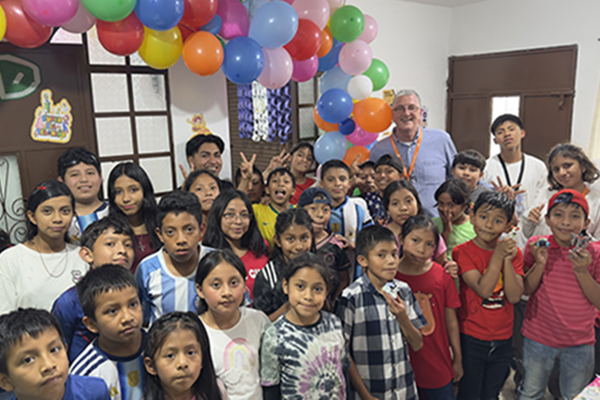
One thing visitors often comment on when they visit CasaClub in Santa Faz is the extraordinary welcome they receive. The children are generous with their hugs, kind words, and genuine appreciation for having a safe, welcoming place where they can spend time together. It is hard to walk through the doors without being surrounded by smiling faces and outstretched arms.
That morning was no exception. The hellos and hugs came thick and fast, and then Antonio appeared. He spotted me from across the room and headed straight for me, arms wide open.
I scooped him up in a hug and immediately realised that something had changed. He’d had another growth spurt, and his voice was starting to deepen. I relaxed my embrace, thinking he might have had enough, but he held on a little longer, so I gave him another hug before placing my hand on top of his head to measure just how tall he had become.
My goodness, he had shot up! “Wow, you are so much taller than you were just a few weeks ago!” I exclaimed. Antonio simply nodded, still holding on. “What happened to the little boy I used to know and mentor?” I asked. He snuggled in a little closer and quietly replied, “He is still here inside.”
 For a moment, I didn’t quite know what to say. It was one of those beautiful, unexpected encounters that remind me why spending time with children is such a privilege. Here was a boy whose body was changing, whose voice was beginning to sound more like a young man’s, and yet who was gently reminding me that growing taller didn’t mean he had stopped needing the things he had always needed.
We stayed together for a while, and our conversation gradually moved towards how he was doing and what was troubling him. I noticed that Antonio kept glancing over his shoulder to see whether anyone was listening. He then began telling me about his mum, who had been very ill, and how difficult things had become at home because she wasn’t being paid when she was too unwell to go to work.
The more he talked, the more I listened. His concerns tumbled out one after another. He was worried about his mum, their financial situation, life in Santa Faz, and almost everything else going on around him, except perhaps the price of fuel!
I smiled to myself at the range of things that were occupying his young mind, but I also recognised something important. Antonio was allowing me into some very private areas of his life, sharing worries that he might not have felt comfortable discussing with others. It was a privilege to be trusted with so much.
As we continued talking, I reflected on how easily we can mistake physical growth for emotional maturity. We see a boy getting taller, hear his voice changing and begin to expect him to behave differently. Yet inside, he may still be trying to make sense of a world that seems increasingly complicated and, at times, frightening.
Antonio was growing up, but the little boy I had known for years was still very much there. And that little boy still needed someone to listen, someone to reassure him that he wasn’t facing his worries alone, and, perhaps most importantly, someone who would simply hold on to the hug a little longer.
Another day brought another visit to one of our mentoring centres. This time, I headed to La Terminal, where our centre is considerably smaller than the one in Santa Faz, but the welcome was just as warm, and the children’s affection was just as genuine.
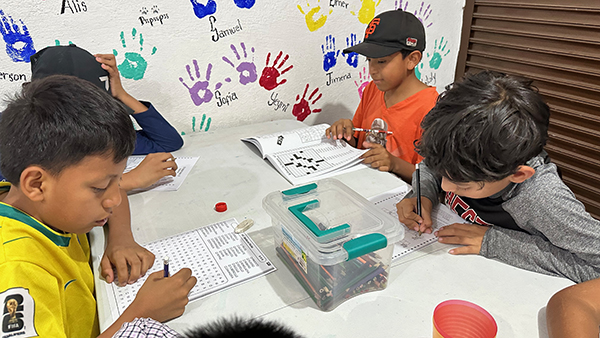
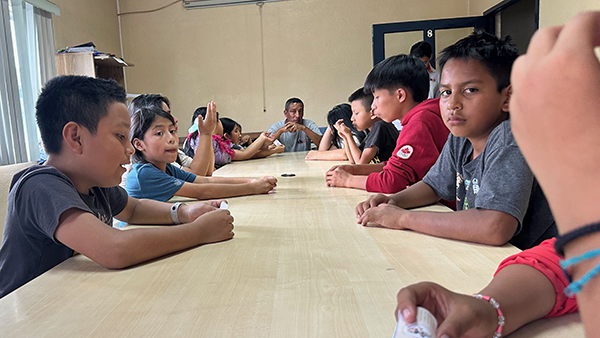
I settled myself onto a small plastic stool and watched the children working on their homework. Christian, one of the boys sitting around the table, had already finished his work and was doing his best to wait patiently while his friends caught up.
 Since he sat next to me, I reached for a scrap of paper and drew rows of dots, which immediately caught his attention. When I had finished, I asked whether he had ever played the game where two people take turns joining dots with lines, trying to complete squares while preventing their opponent from doing the same. He hadn’t, so I explained the rules, and we began playing.
It was great fun, particularly for me, as I won rather convincingly! Christian was clearly not impressed with this outcome and immediately asked for a rematch. This time, having understood the strategy, he managed to beat me, and the delight on his face was wonderful to see.
Before long, other children asked to play, and I was about to prepare another sheet of paper when one of the leaders called everyone’s attention. The subject for the afternoon was trust.
The discussion was interesting, and the children eventually named someone they trusted. Most mentioned their mothers, others talked about friends, and a few named members of the mentoring team.
Then it was Karen’s turn. She smiled and said, “No one!” We all thought she was joking. Then she lowered her eyes to the table and quietly repeated, “No one.” The way she said it the second time made me realise she wasn’t joking at all.
The leader moved on gently, and none of the other children said anything. Many of them knew something of Karen’s circumstances and understood that her life was far from easy.
What happened afterwards, however, was something I found deeply moving.
Several of the children quietly went over to Karen and hugged her. There were no questions, no attempts to offer advice and no awkward conversations. Just a hug. I tried not to stare, but the whole experience felt deeply emotional.
Karen is thirteen. She is growing into adolescence, and I have known enough about her life over the years to understand some of the terrible experiences she has endured. I wondered how she was making sense of everything that had happened to her, especially as she entered a stage of life that brings so many changes and challenges of its own.
From the outside, her smiles, laughter, and sometimes awkward confidence might suggest that she is doing well. But beneath that cheerful exterior are painful experiences and fears that she rarely shares. I could see she was carrying far more than any child should ever have to.
For a moment, I found myself wondering what life might be like for Karen and her sister if they could grow up without abuse. What difference would it make if they could go to bed each night knowing they were safe, that no one would hurt them, and that tomorrow would bring opportunities rather than more fear? What would childhood look like for them if they were simply allowed to be children?
I have thought a great deal about these three experiences over the past few days. Three stories. Three young lives. Three very different experiences of growing up.
Moses, full of confidence and excitement as he discovers the independence that comes with adulthood. Antonio grows taller and begins to sound like a young man, yet still needs the reassurance and affection he enjoyed as a little boy. And Karen, at thirteen, already wears the scars of painful experiences that many adults would struggle to cope with. Each is navigating the complicated journey from childhood to adulthood, but each experiences it very differently.
It has made me wonder how often we look at children and young people through our own adult understanding of what growing up should look like. We see their physical development, their behaviour, their achievements and sometimes their mistakes, but how often do we really understand what is happening inside them? And how might our work change if we could see the world through their eyes?
I am certainly no expert on childhood development. After more than thirty years of working with vulnerable children, I am still learning, still observing and still discovering how much I don’t understand.
But I have become increasingly convinced of one thing. Being there matters. Being there to celebrate the excitement of a first driving lesson. Being there to offer a hug that lasts a little longer than expected. Being there when a child quietly reveals that no one in their life feels trustworthy.
I wish I could take away all their pain. There are days when I would gladly carry it myself if it meant they could enjoy the childhood they deserve. But I can’t. What I can do, and what we will continue to do through our mentoring programmes, is keep turning up, keep listening, keep encouraging and keep loving these children through the different stages of their lives.
And perhaps, most importantly, keep trying to see the world through their eyes rather than expecting them to see it through ours.

Your Content Goes Here
CLICK HERE to find out the answer and how you could help educate a child at risk in Guatemala today
 Duncan Dyason is the founder and Director of Street Kids Direct and founder of TOYBOX UK, El Castillo in Guatemala and SKDGuatemala. He first started working with street children in 1992, when he moved to Guatemala City after watching the harrowing BBC documentary “