
THE SMALL THINGS MATTER
I sometimes wonder whether the world is changing so quickly that we are losing sight of what really matters.
Every day, we are bombarded with news of technological advances, artificial intelligence, political upheaval, economic uncertainty and the latest innovations promising to make our lives easier, faster and more productive. We seem to be living in a world where everything needs to be bigger, better and more impressive than what came before.
Even in the charity sector, we are encouraged to think big, set ambitious targets, measure our impact and demonstrate how many lives we are changing. Don’t get me wrong, I believe these things matter, and after more than thirty years working with vulnerable children, I understand the need to show that what we do really makes a difference.
But I sometimes wonder whether, in our determination to achieve great things, we overlook the small things that can have an equally profound impact on someone’s life.
A smile, a kind word, a hand on a shoulder, remembering a child’s birthday, taking time to listen, or simply sitting beside someone having a difficult day. None of these things cost much, and few would find their way into an annual report or a spreadsheet measuring a mentoring programme’s success.
Yet for a child who has grown up feeling unwanted, forgotten or overlooked, these seemingly insignificant gestures can mean everything.
Over the past week, several encounters have reminded me just how important these small things can be. They were ordinary moments, easily overlooked amid the busyness of running a charity, but each one left me reflecting on something I believe we risk forgetting.
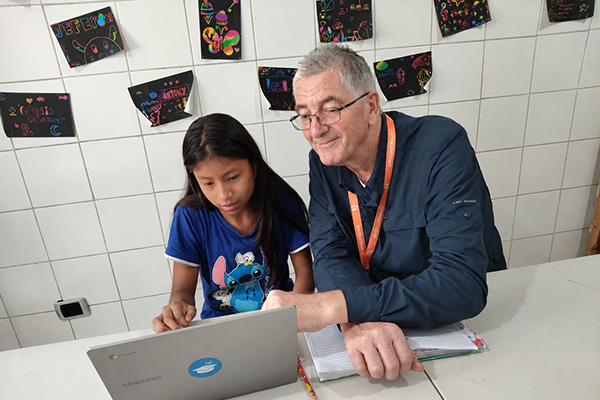
One of those moments came when I was spending time with ten-year-old Astrid, who attends one of our mentoring centres here in Guatemala. Astrid lives in a small tin shack in one of the city’s poorest communities. Her home has neither electricity nor running water, and every day brings challenges most of us would struggle to imagine. Yet, like any other ten-year-old, she goes to school, has homework to do and wants to do well in her studies.
The problem is that the school regularly sets homework that requires a computer, internet access, and a printer. For children like Astrid, who have none of these at home, even the simplest school assignment can be an enormous challenge. Thankfully, she comes to our mentoring centre every day, where she can use the facilities and get the support she needs to keep learning.
I sat beside her as she tried to complete an assignment on a subject she was studying at school. She needed to find information online, but first she had to learn how to use the computer, open a browser and search for what she needed. It would have been easy for me to take over, find the information and help her finish the homework in a few minutes. After all, I could have been doing other things, and the temptation to finish quickly was always there.
But that wasn’t what Astrid needed. She needed someone to sit with her, explain each step patiently, and give her the confidence to try things herself. We worked together, searching for information, reading what we found, and then discussing how she could put what she had learned into her own words. It took time, but I thoroughly enjoyed every minute.
There was something rather special about sitting beside this little girl, sharing in her excitement as she began to understand how to find the information she needed. It was one of those quiet, personal moments when the busyness of the day seemed to disappear and, for a while, nothing else mattered apart from helping Astrid with her homework.
Afterwards, I wondered what difference that small investment of time might make in her life. Perhaps she will remember how to use the internet more confidently or simply remember that someone was willing to sit beside her and help her succeed. For me, it was a small part of my day. For Astrid, I hope it was something much more significant.
A few days later, I was reminded of the importance of small gestures in a very different setting.
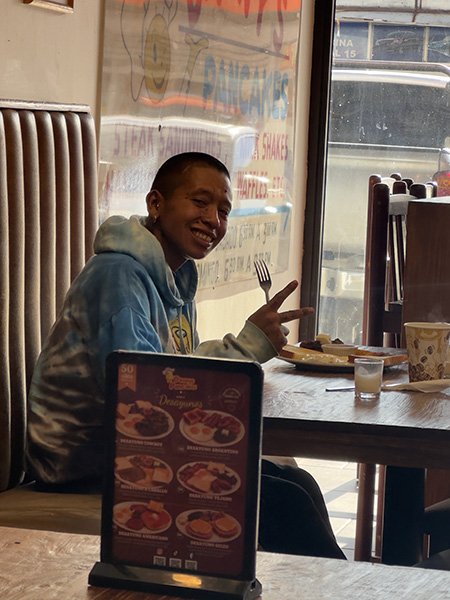 I had arranged to meet a group of friends for breakfast at a café here in Guatemala City. We were enjoying our food and conversation when I noticed a woman walk through the door and ask for a cup of water. I recognised her immediately. I knew her from my time working on the streets and knew she was homeless. She was one of the many people who live on the margins of society, often passing through our daily lives almost unnoticed.
As I watched her stand there, I wondered how long it had been since she’d had a proper breakfast. I turned to my friends and asked whether they would be happy to buy her something to eat. Without hesitation, they agreed, and we arranged to have breakfast prepared for her.
When the food arrived, her face lit up. She seemed genuinely delighted, and I couldn’t resist taking a photograph of her as she smiled over the unexpected meal. It was such a simple thing to do. None of us had made a great sacrifice, and the cost of her breakfast was insignificant compared with the many other things we spend money on without a second thought. But for that woman, on that particular morning, it clearly meant a great deal.
As I reflected on the encounter, I wondered how many people we walk past every day without really seeing them. People who are struggling, people who are lonely, people who have become so accustomed to being ignored that they no longer expect anyone to notice them. They are there, all around us, if only we would take the time to look.
I don’t know what happened to that woman after she left the café, and I certainly wouldn’t pretend that buying her breakfast had changed the circumstances that had led her to live on the streets. Tomorrow she might be hungry again, and the challenges she faces will still be there. But for one morning, someone noticed her. Someone thought about her needs and decided to act.
We cannot solve every problem, reach every vulnerable person or remove all the suffering we see around us. But we can make a difference to the person sitting beside us, the child struggling with homework or the woman who walks into a café asking for a glass of water. Sometimes we become so overwhelmed by the world’s problems that we forget the small things we can actually do. And those small things matter.

Your Content Goes Here
CLICK HERE to find out the answer and how you could help educate a child at risk in Guatemala today
 Duncan Dyason is the founder and Director of Street Kids Direct and founder of TOYBOX UK, El Castillo in Guatemala and SKDGuatemala. He first started working with street children in 1992, when he moved to Guatemala City after watching the harrowing BBC documentary “