
Saturday, 25th July, 2026
Sometimes, the quietest words are the ones that leave the deepest impression.
This week, I visited one of our mentoring centres in Guatemala, where we work with children growing up in difficult circumstances. It had been a good afternoon. The children had enjoyed playing football together, there had been plenty of laughter, and the team had been celebrating those who had worked especially hard at school.
As the children prepared to leave, Julian, one of our team members, handed out prizes for excellent school results. One of the boys, twelve-year-old Anderson, made a comment about how well he had done in school. Julian smiled and replied, “If I was your dad, I would feel very proud of you.” Almost under his breath, but just loud enough for me to hear, Anderson quietly replied, “I wish you were my dad.” He glanced up for a split second to see whether Julian had heard him. He hadn’t. There was too much going on. But I had.
Those six words have stayed with me ever since.
Anderson doesn’t have a father in his life. Nor does he have his mother. Instead, he sleeps at his grandmother’s house and grows up carrying a sadness that is difficult to describe but easy to recognise. There is a vulnerability about him that concerns me. Like so many boys, he longs to belong, to be noticed, to know that someone believes in him.
Research consistently shows that boys thrive when they have a positive father figure in their lives. Children with involved fathers or trusted male role models generally achieve better educational outcomes, develop greater emotional resilience, and are less likely to engage in risky or violent behaviour. Father absence, by contrast, is associated with higher rates of loneliness, depression, and behavioural difficulties during adolescence.
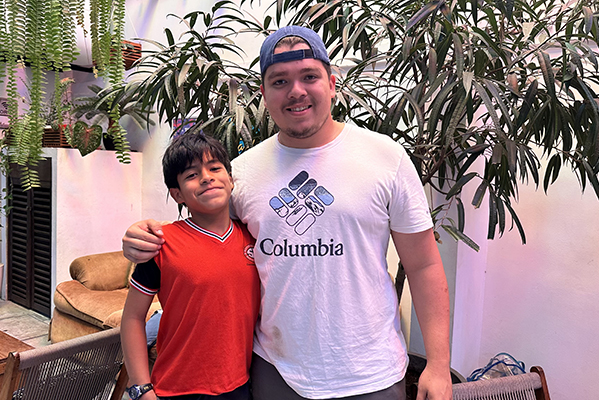
Looking at the photograph above makes me smile. I love the way Anderson instinctively puffs out his chest, stretches himself taller, and stands proudly beside Julian. For that moment, he looks secure. He looks like a boy who knows he matters. Perhaps that is because, for a little while, Julian has become more than just a mentor. He has become the sort of man every boy needs.
Next week, Julian returns home to Honduras. I know that will be a bitter disappointment for Anderson, as the relationship they have built cannot simply be replaced.
As I reflected on that conversation, I realised that I may need to step a little closer into Anderson’s life.
Throughout the Bible, God is described as “a father to the fatherless” (Psalm 68:5).
I have often wondered how He chooses to demonstrate that fatherly love. Perhaps one of the ways He does so is through ordinary men and women who simply show up, week after week, refusing to give up on a child.
This has been a difficult week for many of us here in Guatemala. Yet this photograph gives me hope. Not because every problem has been solved. But because a twelve-year-old boy, if only for a moment, knew what it felt like to stand beside someone who made him feel safe, valued, and proud.
Your Content Goes Here
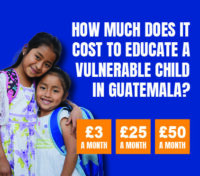
CLICK HERE to find out the answer and how you could help educate a child at risk in Guatemala today
 Duncan Dyason is the founder and Director of Street Kids Direct and founder of TOYBOX UK, El Castillo in Guatemala and SKDGuatemala. He first started working with street children in 1992, when he moved to Guatemala City after watching the harrowing BBC documentary “